
Key points
- Incremental innovation improves existing products in a known market: it accounts for more than 80% of innovations and calls for a defensive patent strategy.
- Adjacent innovation takes a technology you already master into a new market or customer segment, and is a natural ground for licensing.
- Disruptive innovation attacks the market from below with simpler, cheaper offers, and requires fast protection combining patents, designs and trademarks.
- Radical innovation creates a new technology, represents less than 5% of patents filed, and relies on broad fundamental patents and aggressive international extension.
- Each type requires different portfolio management: cost control, competitive mapping, secrecy and traceability, or financing through IP.
Failing to distinguish between types of innovation exposes your company to risky investments and, over time, a fatal loss of competitiveness. Understanding the specific mechanisms of each type is essential to allocate your R&D resources effectively: are you improving what exists, or creating tomorrow’s market? In this guide, PI Motion decodes the four fundamental variants to help you steer your industrial innovation strategy.
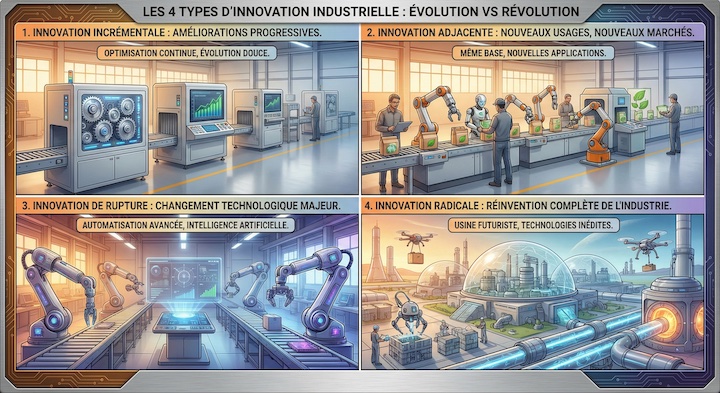
The 4 types of industrial innovation
Industrial innovation is not just about pure technological invention. It results from the combination of a technology and a market. Depending on whether these two variables are new or existing, four main types of industrial innovation emerge. Ignoring this classification means navigating without a compass: you risk applying incremental innovation management methods to projects that require disruptive innovation, for example, which inevitably leads to failure. You also risk setting up innovation metrics that are irrelevant because they are not adapted. (See our article on innovation metrics.)
Incremental
Existing
Existing
Low to moderate
Defensive patents
Adjacent
Existing
New
Moderate (market)
Freedom to operate, licensing
Disruptive
Often simple
New or neglected
High (business model)
Speed, combined rights
Radical
New
New
Very high (technology)
Broad fundamental patents
Incremental innovation: consolidating what exists
Incremental innovation is the most common and least risky form of industrial progress. It consists of gradually improving existing products or processes in a market you know well. It accounts for more than 80% of innovations, hence its fundamental importance in patent management.
- Method: you do not change the rules of the game; you simply play it better than your competitors.
- Objective: optimize performance, reduce costs or add a feature your current customers expect.
- Benefit: do not underestimate this category. It often funds bolder research, and without these constant improvements your market share erodes in the face of more agile competitors optimizing their margins.
Characteristics: existing and mastered technology, existing and known market, low to moderate risk, defensive IP strategy.
In this context, patents often protect minor improvements. They build a thicket of patents around your flagship products and deter competitors from copying you too closely. Incremental innovation is driven by listening to the needs customers express directly: neglecting their feedback means losing a strong and direct source of ideas.
Adjacent innovation: expanding your territory
Adjacent innovation consists of taking a technology or know-how you already master into a new market or customer segment. It is an extension strategy that makes the most of your existing assets.
It is a very efficient strategy for managing your IP portfolio. From a patent perspective, when you have patented a product, the protection granted generally covers all uses of that product, which is a considerable competitive advantage.
- Method: you take a technology proven in your industry and apply it elsewhere. For example, sensors developed for the automotive industry may find relevant applications in home automation or the medical sector.
- Risk: the risk lies in not knowing the new market. Your technology works, but does it fit the codes and uses of the new target? A poor assessment of market adoption will turn your investment into a dead loss.
Special case of the medical field: protection for all uses of a product does not apply in the same way in healthcare. On the contrary, a new patent can be obtained for a molecule already used to treat disease A if it is found to be effective against disease B. This is the principle of the second medical use.
Succeeding with adjacent innovation often requires adapting the product: it is not a simple copy and paste. Overall, adjacent innovation relies on operational agility to develop the business in new directions:
- You need to change distribution channels.
- You need to adjust the marketing message.
- You sometimes need to rework the design or interface.
Example: the history of the aircraft ecosystem shows how engine technologies moved from experimental to military and then civil uses, illustrating these market shifts. Failing to secure new uses with specific patent or trademark filings exposes you to players native to the new market taking over your technology.
Disruptive innovation: the invisible threat
Disruptive innovation is often misunderstood. Unlike radical innovation, it does not necessarily rely on a complex technological feat. It often attacks the market from below, with a simpler, cheaper and more accessible offer. It is an offensive industrial strategy.
It is also a very sensible IP strategy: low-tech or cheap-tech innovation can be effectively protected by patents too, and doing things more simply and at lower cost can generate higher margins.
- Method: established players often dismiss these innovations at first, judging them less efficient than their industrial standards. That is precisely the trap to avoid.
- Impact: disruptive innovation creates a new market by targeting non-consumers or customers poorly served by traditional offers. 3D printing is a striking example: initially limited to industrial rapid prototyping, it paved the way for distributed and personal manufacturing, upending traditional value chains. If you ignore these weak signals, you wake up facing a competitor that has captured the mass market with a radically lower cost structure.
The innovator’s dilemma: for an established company, let alone a market leader, investing in disruptive innovation is difficult, because it often cannibalizes existing high-margin products. Yet not doing so leaves the door open to new entrants.
Key characteristics: simplified use, often lower cost, new users or neglected segments.
Radical innovation: the technological leap
This is the holy grail of R&D. Radical innovation creates a new technology to solve a problem in an entirely new way. It transforms economic structures and generates massive productivity gains. It is the ideal R&D strategy for challengers, and particularly for new market entrants.
Good to know: radical innovation accounts for less than 5% of patents filed. Unfortunately, the value of patents is sometimes reduced to this type of innovation alone, which is a mistake: each type of innovation has its place and justification in an IP strategy at a given time.
- Method: this type of innovation requires heavy, long and uncertain investment. It often originates in fundamental or applied research. Case studies of semiconductors or antibiotics illustrate this model perfectly: scientific breakthroughs that created entire industries that did not exist before.
- Risk and reward: technological risk is at its highest. You can invest millions with no guarantee of a viable commercial result. But if you succeed, you hold a powerful temporary exclusive right and a competitive lead that is hard to close.
Example: SpaceX and its reusable rockets, which NASA could hardly do without today. Yet many were skeptical at first, and the early days were marked by failures.
Nobody achieves radical innovation alone in a garage today, as Apple’s founders famously did in their time. It requires a complex ecosystem:
- Collaboration: close ties with university laboratories and public research organizations.
- Financing: patient capital (sovereign funds, public support) to sustain the R&D phase before commercialization.
- Intellectual property: the patent is vital. Without strong protection of the new technology, you will never recoup the huge initial investment against fast copiers.
Managing the 4 types of industrial innovation with PI Motion solutions
Managing these four types of innovation requires intellectual agility and suitable tools: you do not manage a breakthrough patent the way you manage an incremental improvement. PI Motion software solutions structure this complexity. The examples below are illustrations, not strict rules: other approaches may be equally valid depending on your needs.
Incremental innovation: managing volume
Continuous improvement generates a constant flow of invention disclosures and improvement patents. Volume is the enemy of precision.
- PI Planner centralizes your rights and rationalizes costs, so you stop paying maintenance fees for obsolete or peripheral patents.
- You see immediately which patents protect your current products and which can be abandoned to free up R&D budget.
Radical and adjacent innovation: strategic vision
Before investing in a new territory or a breakthrough technology, you need to monitor patents (read our article on patent monitoring) and see what others are doing.
- Patent Pulse provides precise mapping of the technology environment. You identify white spaces (unpatented areas) for your radical innovation.
- You detect blocking patents before committing unnecessary R&D costs.
- For adjacent innovation, you spot which competitors are starting to file patents in the sectors you are targeting, so you can react before it is too late.
Disruptive innovation: secrecy, traceability and agility
Disruptive innovation often goes through an emergence phase in which speed of execution and secrecy are more critical than immediate patent filing. Before revealing a game-changing technology, you need to lock down your internal assets. This requires rigorous upstream innovation management, for which PI Planner is well suited:
- Know-how and secrecy management: PI Planner records and timestamps not only patents but also know-how and trade secrets. You centralize evidence of ownership (timestamped deposits, laboratory notebooks) alongside your official rights.
- Traceability of ideas: disruption often emerges from a profusion of ideas that must be sorted quickly. PI Planner's invention disclosure module captures concepts as they emerge, links them to their inventors and supports rapid decisions on the type of protection (patent or trade secret) through collaborative approval workflows.
- Lean management: disruptive projects often run on tight budgets and rapid iterations (start-up mode). PI Planner's financial module simulates future protection costs so you can decide immediately whether the budget allows aggressive international extension or calls for targeted protection.
Securing your people: employee inventors
Whatever the innovation, it comes from your teams. Rigorous management of employee inventors is essential to avoid future disputes that could weaken your assets. PI Planner handles the classification of inventions and the additional remuneration of employee inventors where the law requires it (as in France or Germany), legally securing your innovations from the start.
IP issues by type of innovation
Your intellectual property strategy must be strictly aligned with the type of innovation pursued. Applying a uniform policy without taking into account the specific features of each type is a management error.
IP strategy for incremental innovation
Here, the patent acts as a shield. You often file to preserve your freedom to operate and prevent competitors from blocking your own developments.
- Tactic: frequent filings, targeted protection of visible improvements.
- Risk: disclosure. Sometimes secrecy (know-how) is more relevant for manufacturing processes that are hard to detect through reverse engineering.
IP strategy for adjacent innovation
The central issue here is freedom to operate and extending the scope of protection. Since you are transposing an existing technology to a new market or application, you often enter the territory of established competitors you do not know.
- Tactic: check whether your initial patent covers the new application (broad claims) or whether you need to file new improvement patents to protect the specific adaptation of the technology to this new use. Mapping the patents in the target sector is essential to avoid infringement.
- Monetization: this type of innovation is a natural ground for licensing. If you do not have distribution channels in the new market, the most profitable strategy is often to license your technology to an established player in return for royalties, turning your asset into a profit center without massive commercial investment.
IP strategy for disruptive innovation
The danger is the speed of adoption. You need to protect the market concept as much as the technology.
- Tactic: combine patents, designs (for product design) and strong trademarks to occupy the space in the customer's mind.
- Issue: speed. Cycles are short, and protection must be obtained quickly to deter opportunistic imitators.
IP strategy for radical innovation
The patent is the company’s central asset: a tool for exclusion and for financing.
- Tactic: fundamental patents with broad claims, and aggressive geographic extension, because the market will be global.
- Monetization: these patents are often used to raise funds or negotiate cross-licenses with industrial giants to access the market.
Related articles: incremental innovation, adjacent innovation, disruptive innovation, radical innovation, second medical use patents.
In summary
Industrial innovation takes many forms. The type you pursue depends on your business, your market, your maturity and your R&D capabilities, both technical and financial. Incremental innovation ensures short-term survival through competitiveness. Adjacent innovation extends your market while limiting technical risk. Disruptive innovation threatens your current model but offers explosive growth opportunities. Radical innovation builds tomorrow’s industry at the cost of heavy investment.
Other approaches to innovation exist from different angles (open innovation, frugal innovation, service, process or marketing innovation, and more); we will cover them in another article. Each type of industrial innovation requires differentiated management of R&D, marketing and above all intellectual property. To review your portfolio and adapt your management tools to your innovation strategy, contact the PI Motion experts.
FAQ: the 4 main types of industrial innovation
What is the difference between disruptive and radical innovation?
Radical innovation relies on a major technological novelty (for example, the invention of the transistor). Disruptive innovation often relies on a new business model or a simpler technology that makes the product accessible to new customers (for example, early digital photography, lower in quality but more convenient).
Can incremental innovation be patented?
Yes, absolutely, and it is even the most common case. As long as the improvement provides a new and non-obvious technical solution to a technical problem (inventive step), it is patentable. These patents are essential to stay ahead of the competition.
How can radical innovation be financed?
Radical innovation takes time. It is often financed by a mix of equity, public support (R&D tax credits, grants and innovation agency funding) and venture capital, attracted by the strength of the intellectual property (patents) protecting the future technology.
Does adjacent innovation require new patents?
Not always for the technology itself if it is already protected, but often for its new applications. It is crucial to check whether your original patent covers the new field of application or whether new filings are needed to lock down the new market.
Why use software to manage these innovations?
Managing short (incremental) and long (radical) projects at the same time creates administrative and strategic complexity. Software such as PI Planner lets you segment your portfolio, track costs by type of project and ensure each innovation gets the right protection without wasting resources.