
Key points
- A second medical use patent protects the use of an already known substance or composition for a new, specific therapeutic purpose.
- Article 54(5) of the European Patent Convention creates an exception to the novelty requirement for substances and compositions used in medical treatment.
- Since decision G 2/08, a new dosage regime or mode of administration can also constitute a patentable new use, and Swiss-type claims are no longer accepted for new applications.
- The exception does not apply to medical devices, and the application must contain experimental data proving the therapeutic effect at the filing date.
- Second medical use patents help monetize amortized molecules, protect against generics for the new indication and manage a drug's life cycle.
This guide from PI Motion explores the mechanisms of second medical use patents to help you secure your pharmaceutical innovations. Pharmaceutical research does not stop at the first marketing authorization: a known substance can reveal new properties for treating different diseases.
What is a second medical use patent?
A drug patent classically protects a new chemical substance. In that case, a patent on a new molecule protects all uses of that molecule: its use in any derived drug and for the treatment of any disease.
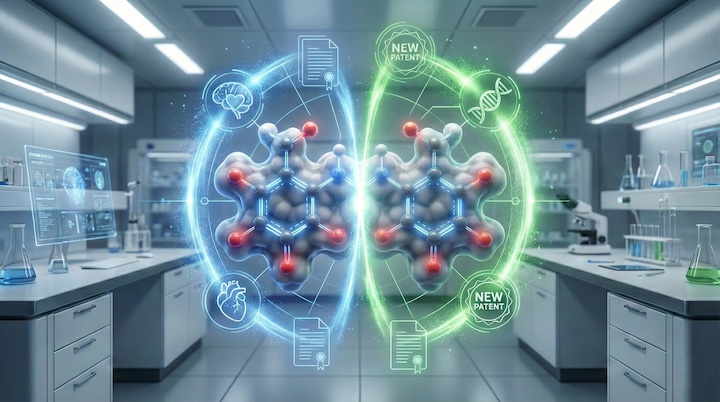
The second medical use, however, makes it possible to patent the use of an already known substance for a new therapeutic purpose. The invention lies in the link between the product (which already exists) and a new specific result to be protected.
The economic value of repositioning
You save valuable time by reusing molecules whose toxicity is already documented. Failing to explore these avenues means wasting technological capital that has already paid for itself. The patent holder thus extends its commercial exclusivity for a specific use.
How it differs from the first medical use
The first medical use of a known substance enjoys broad protection under Article 54(4) of the European Patent Convention (EPC). The second medical use is more targeted: it concerns any specific use that was previously unknown.
The legal framework: Article 54(5) EPC
European law has clarified the protection of these inventions specific to the pharmaceutical and medical sector. The entry into force of EPC 2000 marked a major turning point, and the European Patent Office website details these provisions.
An exception to the classic novelty rule
Normally, a product that has already been disclosed is no longer new. Article 54(5) EPC creates an exception for substances or compositions: the product remains patentable for a specific therapeutic use if that use is not part of the state of the art.
Good to know: it is possible to obtain a new patent for a molecule already used to treat disease A if it is found to be effective against disease B. This is an exception to the usual rules of industrial innovation (see our article on the 4 types of industrial innovation).
Patentability requirements
The invention must meet the four usual patentability requirements:
- Novelty of the therapeutic application.
- A genuine inventive step, not obvious to a person skilled in the art.
- Industrial applicability in the healthcare field.
- It must be an invention within the meaning of patent law (that is, not fall under the exceptions provided by law).
Decision G 2/08: protecting new dosage regimes
Case law has broadened the scope of drug patent protection. Decision G 2/08 of the EPO Enlarged Board of Appeal changed the game by confirming that a different therapeutic treatment is not limited to a new disease.
Patenting a dosage regime
You can now patent a new dosage regime for a drug that is already patented. Moving from three daily doses to a single dose can constitute a patentable invention, if the change provides a superior technical effect.
Optimizing the mode of administration
A new administration protocol can also be protected by a patent. This flexibility allows pharmaceutical companies to better meet patients’ needs, and failing to anticipate these technical variants means missing significant margins.
Why Swiss-type claims belong to the past
Before EPC 2000, the law was unclear, and practitioners used a convoluted construction, something of a legal fiction, known as the Swiss-type claim.
An obsolete claim format
The classic wording was: “Use of compound X for the manufacture of a medicament for treating disease Y”. This detour was designed to get around the prohibition on patenting methods of medical treatment.
Simplified, direct protection
Decision G 2/08 ended this practice for applications filed from January 29, 2011. You must now claim the product directly for a specific use (“Product X for use in the treatment of disease Y”). This clarity strengthens the legal certainty of your rights in healthcare.
Outside Europe: approaches differ by jurisdiction. In the United States, for example, a new medical use is generally protected through method-of-treatment claims rather than purpose-limited product claims.
The limits of the second medical use principle
The second medical use is a restricted privilege: it does not apply to all healthcare products, and there are strict limitations.
Medical devices are excluded
The exception is strictly reserved for substances or compositions. An imaging device or a prosthesis cannot benefit from Article 54(5): such objects follow the general novelty regime.
A proven pharmacological, immunological or metabolic effect
The substance must have a proven pharmacological, immunological or metabolic effect. Research tools or synthesis intermediates do not fall within this framework if they have no direct therapeutic purpose.
The requirement of sufficient disclosure in pharmacology
Filing a patent for a drug is not enough: you must prove that your invention actually works. Insufficient description of the drug’s effects and benefits is a major risk of rejection, or of revocation in court by a competitor. A second medical use patent must be earned, and above all proven.
Proving the technical effect
In pharmacology, the description must demonstrate that the technical result exists. A mere intuition without experimental data at the filing date is fatal: courts systematically revoke patents based only on ideas or intuitions. Your claim must be supported by concrete, indisputable results.
Clinical trials and experimental data
A person skilled in the art must be able to carry out the invention. Your application is stronger if it includes convincing tests. If you wait too long to provide proof of efficacy of the molecule, dosage or mode of administration, your patent will be rejected.
A strategic issue for pharmaceutical companies
The second medical use is a major lever of intellectual property strategy in healthcare and pharmaceuticals:
- Monetizing past R&D: it creates new therapeutic outlets for molecules whose initial research costs have already been amortized.
- Protection against generics: with a patent on a specific new use, the holder can maintain a form of exclusivity on that use, even if the basic patent on the molecule has expired.
- Life cycle management: it is a valuable tool for patent clustering (or evergreening) strategies, which extend the commercial protection of a flagship drug through successive improvements or new indications.
Securing the life of your drug patents with PI Motion
Managing a drug patent portfolio is complex: families extend across many countries, with critical deadlines that vary by region. PI Motion helps you structure the management of your IP rights and master these strategic issues.
Managing maintenance fees with PI Planner
A pharmaceutical patent lasts at most 20 years, and keeping it in force requires regular maintenance fees. PI Planner centralizes the management of your medical patents and other IP rights and automates cost tracking, so you avoid the accidental lapse of your most profitable patents.
Anticipating competition with Patent Pulse
Patent monitoring is vital to identify third-party medical patents that could restrict your freedom to operate. Patent Pulse lets you monitor weak signals and your competitors’ filings. You can:
- Map technology landscapes to find white spaces your drug patent can occupy,
- Track your rivals' geographic extensions,
- Assess the legal strength of your assets before a license negotiation.
In summary
Second medical use patents are a powerful growth lever. They make it possible to exploit known molecules for new therapeutic uses, and case law now also allows new dosage regimes to be protected. The strategy requires absolute scientific rigor to guarantee sufficient disclosure, and managing these assets calls for effective IP software, such as PI Motion’s, to secure investments and maximize the return on R&D.
Do not leave your healthcare and pharmaceutical innovations unprotected. To optimize the IP strategy for your drug patents, contact the PI Motion experts.
FAQ: second medical use patents
How long does a pharmaceutical patent last?
The legal term is at most 20 years from filing. In Europe, a supplementary protection certificate (SPC) can extend exclusivity by up to 5 years to compensate for the time needed to obtain marketing authorization.
What is a second medical use, in practice?
It is patent protection for a substance or composition that is already known (and possibly already patented for a first indication), for which a new specific therapeutic use is discovered. European law allows this new use to be protected even though the molecule itself is part of the state of the art.
Can a new dosage of a known drug be patented?
Yes. EPO decision G 2/08 confirmed that a new specific use can consist of a new dosage regime or mode of administration, for example moving from several daily doses to a single dose, provided it is new and not obvious to a person skilled in the art.
Does second medical use protection apply to medical devices?
No. The novelty exception of Article 54(5) EPC is reserved exclusively for substances or compositions. A medical device, such as a dialysis membrane, a prosthesis or a surgical instrument, cannot benefit from it.
Are Swiss-type claims still valid?
No, for European applications filed from January 29, 2011. Since EPC 2000, Article 54(5) allows the product to be claimed directly for a specific use (“Product X for use in the treatment of disease Y”).
Why could my patent be revoked for insufficient disclosure?
If you do not provide experimental evidence of the therapeutic effect at the filing date, the patent is considered a mere idea and can be invalidated.
How can I check whether a new use of a drug is already patented?
Carry out a thorough prior art search in patent databases. Tools such as Patent Pulse let you map the state of the art and check whether the new indication, or a similar dosage, has already been disclosed or claimed by a third party.