

Key points
- Incremental innovation improves existing products, services or processes in a market the company already knows, with low technological and commercial uncertainty.
- It generates predictable cash flows that fund riskier R&D projects and preserves price competitiveness in mature markets.
- Protecting small improvements builds a patent thicket around flagship products and extends protection beyond the life of the original patent.
- Its main risks are the innovator's dilemma and the accidental infringement of third-party patents in crowded markets.
- Managing a large volume of improvement patents requires tools to control costs, monitor competitors and highlight portfolio value.
So what is incremental innovation, and what are its strengths? PI Motion decodes its mechanisms, its legal stakes and how to turn it into a lever for sustainable growth.
Incremental innovation is one of the four main types of industrial innovation. The other three are adjacent innovation, radical innovation and disruptive innovation. Understanding its mechanisms means mastering the art of lasting in a competitive market; leaving it out of your strategy means watching your competitive advantage melt away slowly but surely.
Defining incremental innovation: the art of continuous improvement
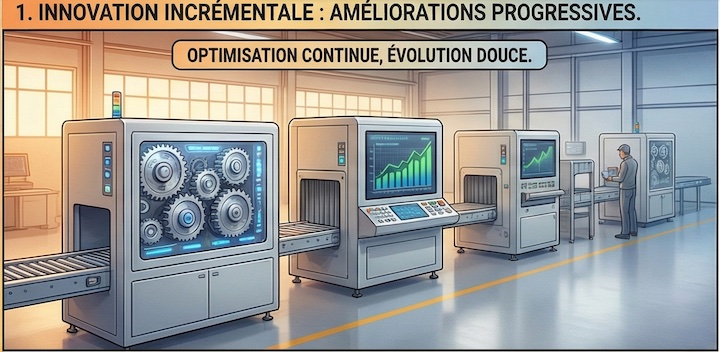
Incremental innovation is the gradual improvement of existing products, services or processes. Unlike disruptive innovation, which creates new markets, the incremental approach aims to consolidate the company’s position in a market it already masters.
A logic of optimization
Incremental innovation does not change the rules of the game; it simply lets you play better than your opponents. The objective is twofold: optimize the performance of the offer for the customer and reduce production costs for the company. It can also adapt the product to the market, or to technological, environmental, social or regulatory changes. The reasons are many, but incremental innovation always improves an existing product by modifying it at the margin, partially, without necessarily redesigning it completely.
It is characterized by low uncertainty, both technological and commercial: you know your customers and master the core technology. The risk of failure is therefore limited compared with launching a radically new product. However, the innovation premium is also lower, generating more modest but more regular revenue.
Listening to customers as a driver of innovation
The starting point of incremental innovation is often careful listening to the needs explicitly expressed by current customers: adding a feature, improving ergonomics, making the product faster or more energy-efficient. Ignoring this feedback gives your competitors the opportunity to satisfy your customers in your place. Incremental innovation is therefore intrinsically linked to a strategy of customer loyalty and market share defense.
Why incremental innovation is vital to your economic survival
Betting solely on technological breakthroughs is a dangerous gamble. Lasting companies know how to exploit their current assets to fund their future inventions, like a tennis player relying on their best shot to keep the opponent at bay.
Highly profitable, it funds tomorrow's R&D
Products resulting from incremental innovation generate immediate and predictable cash flows. This revenue is essential to fund the R&D budget for riskier, longer-term projects. Without this solid base, the company risks liquidity crises while waiting for the hypothetical success of a radical innovation. Refusing to invest in incremental innovation means cutting off your research department’s supply: a management error that weakens the whole structure.
It maintains the price competitiveness of your products and services
Incremental innovation covers many aspects of industrial innovation: improving, perfecting, simplifying a product, making it more robust or cheaper.
Example: process innovation. By improving production efficiency, you reduce unit costs. In mature sectors where price wars rage, this ability to cut costs through small technical improvements is an excellent way to preserve margins. If you do not do it, your competitors will, and they will be able to lower their prices and push you out of the market without inventing a revolutionary product.
Concrete examples of incremental innovation in industry
Looking at proven examples helps grasp the scope of the concept. These cases show how minor adjustments can have a major market impact.
Example 1: smartphones
The mobile phone market is the archetype of incremental innovation. Since the launch of the first iPhone (a disruptive innovation), each new version brings its share of improvements: a sharper screen, a faster processor, a longer-lasting battery. These changes do not alter the fundamental use of the product, but they make the previous version obsolete in consumers’ eyes. A manufacturer that misses an improvement cycle immediately loses market share: it is a race in which stopping is not an option.
Example 2: medical devices
In the medical field, incremental innovation is often preferred for safety and regulatory reasons. Micrel, for example, uses patents to protect improvements to its infusion pumps. Similarly, Picote developed mechanical tools to repair pipes without digging, adapting an existing technique to smaller diameters. These examples show that even minor changes, if they meet a critical need (less pain, less invasive intervention), create considerable value.
Example 3: the automotive industry
Adding parking assistance sensors or optimizing fuel consumption through better electronic engine management are typical incremental innovations. They fit into an existing vehicle architecture. A manufacturer that does not integrate these standard developments quickly finds its range perceived as outdated, forcing value-destroying discounts.
The right intellectual property strategy for incremental innovation
A common mistake is to think that only major technological leaps deserve a patent. In reality, protecting small improvements is a formidable defensive strategy.
Building a patent thicket to occupy the ground
During a product’s growth or maturity phase, the aim is to block competitors trying to copy your improvements or offer similar products. The tactic is to file multiple patents on minor improvements, implementation variants or optimized manufacturing processes, creating what is known as a patent thicket. If you do not protect these increments, you leave gaps for competitors to design around your original patent. Worse, they could patent an improvement to your technology and block you in your own market: filing such patents yourself is a sound offensive strategy.
Extending the life of your exclusive position
A patent has a limited lifetime (20 years at most). Incremental innovation lets you file new patents that, in effect, extend protection around a flagship product. By regularly patenting improvements, you maintain a constantly renewed barrier to entry. The pharmaceutical industry uses this strategy extensively (known as evergreening), patenting new dosage forms or modes of administration for existing drugs, alongside the second medical use principle, which is specific to the pharmaceutical sector. Not using this lever means letting your product fall into the public domain sooner than necessary.
Freedom to operate as a priority
With incremental innovation, you often operate in a crowded market. The main risk is not so much copying as unintentional infringement of third-party patents: every small change to your product can bring it within the scope of a competitor’s patent. Patent monitoring and freedom-to-operate studies become crucial. They not only check whether you can sell, but also identify technological white spaces where you can still innovate safely.
Read also: our practical guide on patent monitoring.
The hidden risks: the innovator's dilemma
Incremental innovation is necessary, but it must not become a rut. Focusing solely on improving what exists carries a major strategic risk: blindness to disruptive innovation.
Listening too closely to current customers
By focusing exclusively on the demands of current customers, who often ask for incremental improvements, the company may miss the emergence of new needs or market segments. This is the famous innovator’s dilemma: by perfecting its technology for its best customers, a company leaves the field open to players offering less powerful but cheaper or simpler solutions, which eventually upend the market.
R&D resources cannibalized
Incremental innovation is reassuring and profitable in the short term. It tends to absorb all R&D resources, leaving nothing to explore new territories.
Alert: if you do not consciously allocate part of your budget to riskier projects, you will optimize your product until it becomes perfectly useless in the face of a new disruptive technology. You need to manage exploitation (incremental innovation) and exploration (radical innovation) at the same time.
How PI Motion secures and enhances your incremental innovations
Managing incremental innovation involves handling a large volume of data: multiple patent filings, varied deadlines, competitor monitoring. Classic tools such as spreadsheets quickly reach their limits and expose you to costly errors. PI Motion software solutions are designed to turn this complexity into a strategic advantage.
Managing the volume of IP rights with PI Planner
Incremental innovation often produces a large patent portfolio, and each patented improvement generates maintenance fees and administrative procedures. PI Planner centralizes all your rights and shows the associated costs immediately. You can identify patents protecting features that have become obsolete and decide to abandon them to reallocate budget to protecting your new improvements. Without this management tool, you risk paying for rights that no longer bring anything, draining your cash for nothing.
Securing freedom to operate with Patent Pulse
Before launching a product improvement, you must be sure you are not encroaching on third-party rights. Incremental innovation often takes place in sectors with high patent density. Patent Pulse lets you monitor competitors’ filings and analyze the technology environment. You detect problematic patents early and can steer your R&D toward technical solutions free of rights. Not using such a monitoring tool means navigating a legal minefield blind.
Highlighting the financial value of your patent portfolio
A patent portfolio, even one made up of incremental innovations, has strong financial value. It reassures investors and can serve as bank collateral or a bargaining chip in negotiations (cross-licensing). PI Planner helps you structure this asset and present its consolidated value, turning a collection of small patents into a powerful financing lever.
Financing improvement: R&D tax incentives
A persistent misconception holds that only revolutionary breakthroughs qualify for public support. This is wrong: many countries support companies’ continuous improvement efforts through R&D tax incentives.
Eligibility of incremental innovation
In France, for example, work must represent a “substantial improvement” and not simply result from using the state of the art to qualify for the research tax credit (Crédit d’Impôt Recherche, CIR): it must overcome technological obstacles, even modest ones. Incremental innovation may also qualify for the innovation tax credit (Crédit d’Impôt Innovation, CII), designed specifically for SMEs, which funds the design of prototypes of new products with superior technical performance, ergonomics or features. Similar schemes exist in many other countries.
Our advice: consult a specialist to confirm which funding criteria apply to you.
Do not lose money through ignorance
Many companies fail to declare this work, thinking it is “not innovative enough”. That is a straight loss of cash: personnel costs, depreciation and patent costs related to these improvements can often be recovered. With PI Motion tools, you can trace these projects and the associated patents precisely, making it easier to build your funding applications and secure your claims with the tax authorities.
In summary
Incremental innovation is not optional: it is a management necessity. It ensures short-term profitability and funds long-term research. It requires a rigorous defensive IP strategy (patent thicket) to block competitors. It must be balanced so as not to blind the company to market disruptions. And it requires effective management tools to control costs and risks.
Do not leave your small improvements unprotected and unmanaged: they are the real day-to-day value of your company and help you prepare for the future. To structure your innovation approach and secure your portfolio, contact the PI Motion experts.
FAQ: incremental innovation
What is the difference between incremental and disruptive innovation?
Incremental innovation improves an existing product or service for existing customers (for example, moving from one smartphone generation to the next). Disruptive or radical innovation creates a new market or profoundly transforms uses, often with a new technology that makes previous products obsolete (for example, the shift from film to digital photography).
Can incremental innovation be patented?
Yes, absolutely, and it is even the most common case. As long as the improvement provides a new and non-obvious technical solution to a technical problem (inventive step), it is patentable. These patents are essential to stay ahead of the competition and block imitators.
Is incremental innovation eligible for R&D tax incentives?
Often, yes. In France, for example, it may qualify for the research tax credit (CIR) if it involves solving technical difficulties rather than simply applying existing know-how, or for the innovation tax credit (CII) for SMEs if it concerns new products with superior performance. Rules vary by country.
What are the risks of incremental innovation?
The main risk is the innovator’s dilemma: by focusing only on improving current products for current customers, a company may miss a disruptive technology that makes its offer obsolete. There is also the risk of infringing third-party patents, which is high in mature markets.
Why use software to manage incremental innovation?
Incremental innovation often generates a large number of patents and IP rights to manage (filings, extensions, maintenance fees). Software such as PI Planner centralizes this data, monitors costs and ensures that each right is kept in force strategically, avoiding unnecessary spending on outdated technologies.